
A New Perspective: Call to Action
Inclusive projects providing appropriate and meaningful engagement will be more expensive.
- Funding should be long-term to have maximum benefit for participants and so that providers can continue to learn from their experiences and build on their successes
- Communication and reporting should reflect the realities of practice and its meaningful outcomes
- Costs per head may be greater due to smaller group sizes and greater support costs
- Project budgets should include resources for training, planning and evaluation
- Consider incorporating additional necessary costs such as specialised staffing, inclusion of those with lived experience at planning and delivery level, and practical adjustments to make activity fully accessible
- Make use of available networks to learn about and share best practices to ensure value for money
Through A New Perspective
We wanted to find out how far the recommendations in the Stand up for SEND document had impacted on practice for Arts organisations and schools in applying for funding for their projects as well as for funders who are considering applications for support.
Areas looked at:
- Interest from funders:
– Funding
– Multi-year funding - Costs that are covered by funders and costs that are more challenging to secure
- Covering costs
- Commitment of own financial resources
Interest from funders
The perception of those who were surveyed is that there is an overall increased level of interest from funders to support arts activity and delivery to the benefit of those with additional abilities.
As previously stated, the fact that there is a high level of interest from schools to participate in funded activity, seems to indicate that this increased level of interest from funders would therefore be welcomed.
Bearing in mind the number of organisations that do not feel confident in the area of funding, it would seem necessary to address this so that where funds do exist to support activity, organisations need to be made aware of where and how to apply and have increased confidence to do so.
Organisations and schools were asked what changes, if any, they had noticed from funders since 2019 in relation to supporting activity for young people with special educational needs and/or disabilities. Most schools and organisations reported either no change or increased interest; the most common response was ‘no change’, which was reported by 41% of schools and 48% of organisations. More than a third of respondents stated that they saw an increased level of interest from funders in funding activity young people with special educational needs and/or disabilities (38% of organisations and 37% of schools).
Schools were more likely than Arts organisations to report that they saw a decrease in interest from funders in relation to supporting delivery for young people with special educational needs and/or disabilities, with over a fifth of schools saying this (22%, compared with 14% of organisations).
Funding
Multi-year funding
Stand up for SEND called for funding to be long-term to build solid partnerships so that Arts providers and special schools can learn from their experiences and build on their successes. We asked if schools and Arts organisations had secured long term funding: only 15% of schools had secured multi-year funding and 50% of Arts organisations. Given that Arts organisations largely rely on external funding to deliver projects, the fact that only half of the respondents managed to secure multi-year funding is disappointing.
Given the fact that Arts organisations are more reliant than schools on securing grant funding to run their operations, it is not surprising that significantly more Arts organisations than schools have managed to secure multi-year funding. There are fewer funding opportunities for schools generally and those that are available often focus on single-year project-based grants rather than multi-year grants.
What do funders need to understand better?
- Intersectional delivery can dilute some of the intended impact.
- Partner venues, who need to get income from paying bookings, sideline the outreach work.
- There are limited activities that are fully inclusive for severe cases of disability combined with medical needs.
- Special educational needs are often lifelong.
- the scale of the number of SEND students.
- the impact it has on the family units, socially, financially and from a mental health perspective.
- Partnership models can mean not having ‘own’ beneficiaries.
- There is a need for funding of the process, particularly with a co-design approach where the outcome isn’t exactly clear, as that is part of the co-design process.
- Not including siblings or families in the number of beneficiaries.
- Research and development of a programme with the community should be recognised as important with an understanding of related costs and staff time.
- More and more statistics are being required to support a funding application to demonstrate need – these statistics are not always available.
School
The challenge of long-term and full cost recovery funding
- Many funders will only give funding for 12 months and then application is not permitted for a further 3 years. When a school is involved, there is a new year group every year, so although the school is the same, the students change.
- Covering the full cost of projects (a full cost recovery approach) and securing significant/large grants over a longer period than 1 year.
- Some funders don’t accept the need to operate on a Full Cost Recovery basis to secure the sustainability of a charity.
- Asking for the amount of money that is really needed to produce quality work in this area.
- Getting continuous funding for established projects.
- Core costs are always hardest to fund.
“…without core costs covered, delivery is impossible!”
Arts Organisation
There are specific issues pertaining to fundraising for projects working with children with additional needs. These include:
- the frequent need to provide high ratios of support, sometimes as much as 3:1
- the need to use experienced / additional staff
- sessions need to be delivered over a long period of time to provide consistency for young people
- high-quality multi-sensory resources are expensive
- support for some individuals needs to be lifelong
- the numbers of young people that engage may be quite small.
Organisations highlighted some of the main challenges of fundraising being:
- the short length of existing funding periods
- the need for funding breaks between applications
- only counting those participants who have special needs as beneficiaries of a project.
Schools and organisations highlighted the following considerations:
- the scale of the number of young people needing support
- the impact on family units (socially, financially and from a mental health perspective)
- the need to improve understanding of those providing funding
“Without outside charities we would have nowhere near the amount of opportunities for our students to participate in arts within the community.”
School
Considerations
Information in relation to grant funds should be made readily available and accessible to those who feel less confident to source and make applications.
Through funding networks or other means, information should be shared between organisations.
Application processes and criterion to be made as clear as possible and where possible funder input to support the process.
Funder Perspective
There seems to be a general acceptance by funders of the higher cost per head for inclusive projects.
In some cases, this is communicated through funding guidelines and in funder organisations discussions.
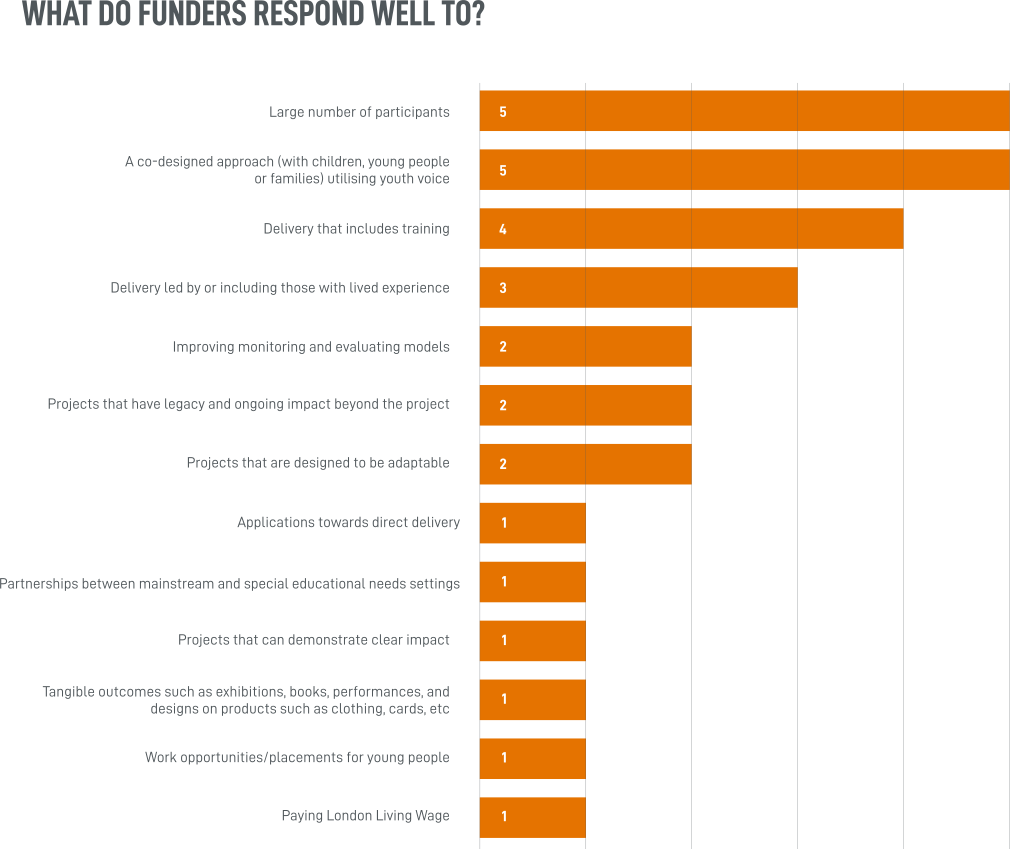
In response to “Do you recognise that the delivery of projects for children and young people with special educational needs and/or disabilities may be more expensive? The responses included:
Of the funder responses received in relation to legacy the comments were as follows:
Considerations
Share, across the sector, an understanding of the specificity related to engagement opportunities and delivery, for and with the young people.
Ensure that the funding application process and reporting criteria relate in a meaningful way to the realities of the needs of the young people and that due consideration is given with regard to what constitutes value for money.
Funders need to be explicit in their funding guidelines to ensure greater confidence is given to applicants to make successful applications.
Highlights from roundtable
Covering Costs
We asked Arts organisations to what extent grant funding covered the various components associated with delivering projects. In the majority of cases, some costs are being covered in the identified areas. It is evident that there are some funders that are willing to cover the total cost in the identified areas as shown from a fifth to a third of organisations stating that all costs are being met. However, approximately a third of organisations on average are saying that their costs are not being met at all in these areas, and for none of the areas listed did the majority of organisations state that their costs were covered fully.
79% of organisations stated that planning and evaluation costs were covered to some extent.
Of those 34% stated that costs were fully covered.
71% of organisations stated that additional staffing costs were covered to some extent.
Of those 31% stated that costs were fully covered.
70% of organisations stated that training costs were covered to some extent.
Of those 19% stated that costs were fully covered.
68% of organisations stated that practical adjustments costs were covered to some extent.
Of those 20% stated that costs were fully covered.
60% of organisations stated that transport costs were covered to some extent.
Of those 21% stated that costs were fully covered.
The most challenging area to secure funding for, either fully or partially, was transport costs. Significantly a large number of organisations were not able to secure funding in any of the areas, with planning and evaluation generally being the easiest to apply for funding towards.
Commitment of financial resources
The majority of schools (56%) and in particular Arts organisations (83%) had committed some of their own resources to embed long-term partnerships. This demonstrates that both schools and Arts organisations are subsidising the costs of projects in order to make sure things happen. It is often necessary for organisations to commit their own resources to demonstrate commitment to the project and some funders require schools to commit their own resources, or in-kind contributions.
What more needs to be done?
Encourage organisations to include real costs in their applications.
Identify those funders that provide contributions to costs in important areas to support this work.
Encourage more funders to consider the full cost implications to support activity for d/Deaf, disabled and neurodiverse children and young people.
Encourage the sharing of information to help organisations through the application process.
Organisations also wanted to be able to include the following areas in their budgets for funding applications:
Staff and Training
- well-being support for delivery staff
- staff cover costs
- inclusivity training costs
- technician for rehearsal sessions
Management and Administration
- true cost of administration/project management/core resources
- managing capacity costs – more paid roles within the organisation.
- programme manager salary & on costs
- back-office costs
Planning and Development
- designated planning costs
- research and development regarding scaling up
Other
- PA costs
- marketing and photos
- costs to cover rise of inflation and unforeseeable cost of living crisis
- access costs at events
- facility improvement costs i.e. lift, specialised furniture
- transport to arts provisions for students who are in wheelchairs (school response)
Considerations
Additional comments, achievements, challenges in relation to funding


© Copyright 2020 – John Lyon’s Charity. Design: Pad Creative
Registered Charity No. 237725