
Background
The Perspectives series has largely focused on the relationships between Arts organisations and special schools and the factors that contribute to making successful relationships built on trust and shared responsibility. Perspectives (2016) identified that the most successful relationships had a clearly defined role for both the delivery organisation and for the teachers at the school, utilising the expertise of both sides effectively. In 2019, Change of Perspectives highlighted that there had been some positive changes made in developing relationships and this trajectory is demonstrated through the data gathered in 2023:
- Both organisations and schools were in agreement in relation to the effectiveness of partnerships, with more than half of the respondents stating that since 2019 partnerships were more effective (53% of organisations and 56% of schools).
- 89% of schools and 84% of organisations stated that partnerships are more effective or still as effective as they were in in 2019.
There is a very high level of interest from schools to engage with Arts enrichment activities, both from the point of view of schools themselves and from the point of view of Arts organisations:
- 97% of organisations stated that there is a moderate to high level of interest from schools in participating in funded activity.
- 100% of schools stated they were “interested” in participating in Arts/enrichment activities with 85% stating they had “a great deal of interest”.
Schools and organisations had different experiences when it came to special educational needs or disability network membership. Over half of organisations (57%) stated that they do not belong to a special educational needs or disability network, compared to one in five (19%) schools. On the other hand, schools were more likely to be unsure, with 37% stating that they were not sure whether they belong to a special educational needs or disability network or not, compared with 10% of organisations.
Bearing in mind the number of external forces (explored below) that could have affected partnerships, it is a positive outcome that the sector is in a good position in relation to its partnership working.
It is intended that the A New Perspective initiative will identify and signpost additional support for organisations where partnerships are less effective.
What factors impact on successful partnerships?
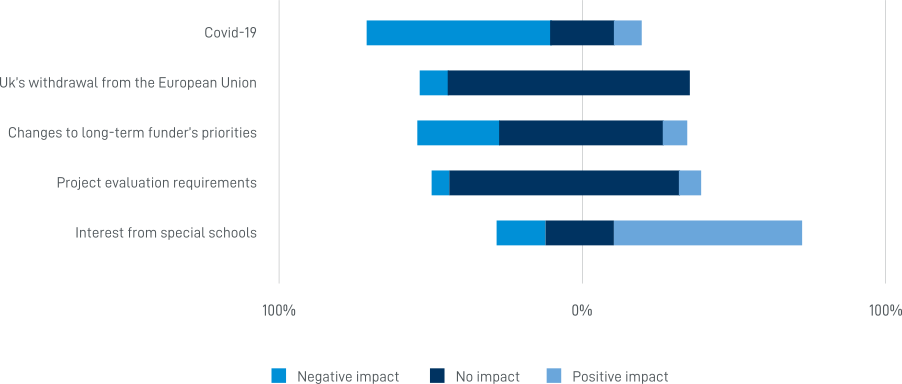
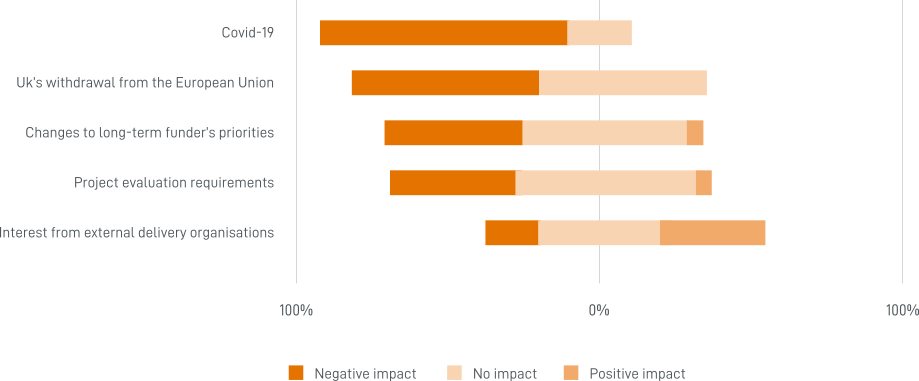
We wanted to find out how the context post-Covid 2019 had impacted on Arts partnerships. Schools and Arts organisations were asked whether the following had a positive, negative, or no impact on their ability to engage with each other:
- Covid-19
- UK’s withdrawal from the EU
- project evaluation requirements
- changes to long-term funders’ priorities
- interest from schools/Arts organisations.
We discovered that:
- Both schools and Arts organisations said that the most positive impact was the interest from partners. This suggests that there is a greater willingness from schools to engage with Arts organisations and also for Arts organisations to work with them.
- Both schools and Arts organisations agreed that the most negative impact by far was Covid-19. We know that special schools were closed to external visitors for an extended period of time during the pandemic and many only started working with face-to-face organisations in this academic year (23/24). Despite this, there were some positive developments in the way projects are delivered, for example, use of technology was accelerated by the pandemic.
- Changes to long-term funders’ priorities had the second most negative impact for Arts organisations and the third most negative impact for schools, although it should be noted that more organisations and schools felt this had no impact on them than had a negative impact.
- For schools, the second most negative impact was due to the UK’s withdrawal from the EU, while the vast majority of Arts organisations felt this had no impact.
Organisations
Schools
Funders stated that the most positive impact on changes to their organisation’s funding of projects had been the appetite from schools and delivery organisations as well as changes to their own funding criteria. As with schools and Arts organisations, Covid-19 was seen as a negative impact.
“due to the vulnerability of SEND pupils it was difficult for arts organisations to access special school for direct delivery.”
– Funder
Levels of confidence
Organisations and schools were asked to express their levels of confidence in key identified areas:
- making adaptations to meet specific need
- developing partnerships
- using appropriate language/terminology
- reporting in a meaningful way on outcomes
- monitoring and evaluating
- fundraising
The survey results revealed that overall, Arts organisations feel “confident” or “very confident” in most of these areas. However, in some areas where they display slightly lower levels of confidence, such as monitoring and evaluation, schools displayed a high level of confidence. While Arts organisations were unsurprisingly far more confident than schools in fundraising for their activities, it should be noted that out of all the areas listed, organisations were still most likely to report that they did not feel confident fundraising for activities for D/deaf, disabled and neurodiverse young people, similarly to schools. Both schools and organisations displayed the highest levels of confidence around the appropriate use of language/terminology and making adaptations to meet specific needs. This is encouraging in the context of delivering projects for young people, and suggests that Arts organisations in particular are gaining in experience working in this field.
Organisations were most confident in the following areas:
- Making adaptations to meet specific needs (97% confident or very confident)
- Using appropriate language/terminology (92% confident or very confident)
- Developing partnerships (88% confident or very confident)
Organisations were least confident in:
- Fundraising for activities (26% not confident)
- Monitoring and evaluating (17% not confident)
- Reporting in a meaningful way on outcomes (15% not confident)
Schools were most confident in:
- Providing guidance/advice regarding appropriate use of language/terminology in relation to special educational needs or disability (96% confident or very confident)
- Providing guidance on the appropriate levels of monitoring and evaluation of participants (96% confident or very confident)
- Providing guidance/advice in relation to making adaptations to meet specific need (92% confident or very confident)
Schools were least confident in:
- Fundraising for the delivery of additional Arts activities in the school (58% not confident)
- That external Arts organisations will meet the needs of students (25% not confident)
This would suggest that organisations should look to their partner schools to support their monitoring and evaluation of projects to utilise their expertise, as 96% of schools felt confident providing guidance on the appropriate levels of monitoring and evaluation, compared to 83% of organisations. Both schools and Arts organisations felt fairly confident with using appropriate language/terminology, although schools were much more likely to report that they felt ‘very confident’ with this (73%, compared with 30% of organisations).
Schools and Arts organisations were equally confident when it came to developing partnerships with each other (88% confident or very confident), which is a definite increase in the levels of confidence suggested in the 2016 Perspectives report. Fundraising for activities stands out as the area where schools and organisations most need to improve their confidence, especially schools, over half of which were not confident in this area. There is also concern among some schools about meeting the needs of their students, with one in four (25%) not confident that external organisations will meet these needs. This is clearly an area that would need to be addressed for successful partnerships to be established.
The Funder Perspective
There have been some changes in priorities that have impacted on applicants. In some cases, funders have recognised that this may have posed difficulties for some organisations.
There is acknowledgement from funders that impact is often difficult to measure although physical visits to observe work has come across positively. Some funders, including John Lyon’s Charity, have recently changed their grant making policies, making it easier for some organisations to secure longer term funding to increase the security of organisations and create longer-term projects and partnerships.
The main factors contributing to the success of project partnership include:
- partnership listening and peer learning
- the delivery organisations developing bespoke, responsive work, that is co-constructed with the School Setting (no off-the-shelf type approaches, or ‘one size fits all’).
- work that fully includes school staff of all kinds (i.e. not just teachers)
- work that centres on the young people, respects them, values what they can do (rather than focusing on what they can’t do).
- delivering long-term projects at regular intervals
- person-centred – working with families
- trained specialist arts practitioners.
- preparation work with special schools
- adaptive delivery
Considerations
There is a very high level of interest from schools to engage with arts activity.
Any organisation starting out on its journey may need support in key areas. Therefore, any support that is readily available and easily accessible would go some way to increase the knowledge and understanding of these organisations, with the potential to increase their level of confidence in these important areas.
In project partnerships, the arts organisation is likely to be the lead in terms of funding applications. Having said that, it is important that all partners have a clear understanding and are confident to feed into the reporting process in relation to the project outcomes.
Schools have stated their high level of confidence in monitoring and evaluating, therefore it would seem apposite that schools work with their partner organisations to increase confidence and understanding in this area. This may have the knock-on effect of having a positive impact on reporting in a more meaningful way in relation to outcomes.
It is extremely important when working in partnership that there is a high level of confidence that the needs of the students are being met.
In the majority of cases this level of confidence exists.
Where it does not, there obviously needs to be more discussion to achieve an agreed level of understanding to ensure that the needs of students are being met. This two-way discourse will help to ensure that organisations have a greater understanding of needs and also that schools are aware of what and how organisations aim to do to achieve this.
There is a great willingness from schools to access opportunities for the children and young people.
In many cases there are strong relationships with both existing and new schools.
However, there are real challenges, identified by many organisations. This includes the impact of Covid-19 , school and staff capacity, as well as the financial difficulties that schools and organisations are experiencing.
It is evident that organisations have been able to make steps to re-engage with the sector following the pandemic but the many factors impacting on the young people and schools’ ability to engage may take time, perseverance, and additional funding to address the areas identified for additional support.
The impact of reduced funding in real terms, as well as staff capacity, have been cited as major factors in a school’s ability to engage in arts activities. However, there is a growing understanding between schools and Arts organisations regarding how to work more effectively to the benefit of the children and young people.
In addition, there are obvious benefits to partnership working not least the role that Arts organisations play in securing additional funding to enable the activities to take place.
Recommendation
Key areas for support have been identified as fundraising, monitoring/evaluating and reporting for Arts organisations.
It is recommended that these specific areas are targeted for further discussion leading to the possibility of additional organisational support. Practical solutions should be shared to support organisations to increase their level of confidence in these areas.
Where schools feel that the needs of the students are not being met, there needs to be honest discourse to ensure a mutual understanding of needs and how best these should be met.
Effective partnership practices should be shared widely to positively influence the development of partnerships where levels of confidence need to be built.
As Arts organisations are primarily the applicants for funding to support arts opportunities it would seem important to ensure that funding opportunities, to support this work in schools and in the sector, are signposted and support is given as necessary to aid understanding of the various applications processes.
Factors
Arts organisations: factors that have positively impacted on relationships
Arts organisations: factors that have created challenges
Schools: factors that have positively impacted on relationships
Schools: factors that have
created challenges
Stronger Voices Together
Stronger Voices Together, the John Lyon’s Charity podcast champions and promote inclusive opportunities for children and young people with learning and access needs.
The Cultural Capital Gap: More needs to be done, together
In this episode of Stronger Voices Together, guests advocate for the transformative power of creativity, confidence, and communication skills that are nurtured through Arts education.


© Copyright 2020 – John Lyon’s Charity. Design: Pad Creative
Registered Charity No. 237725