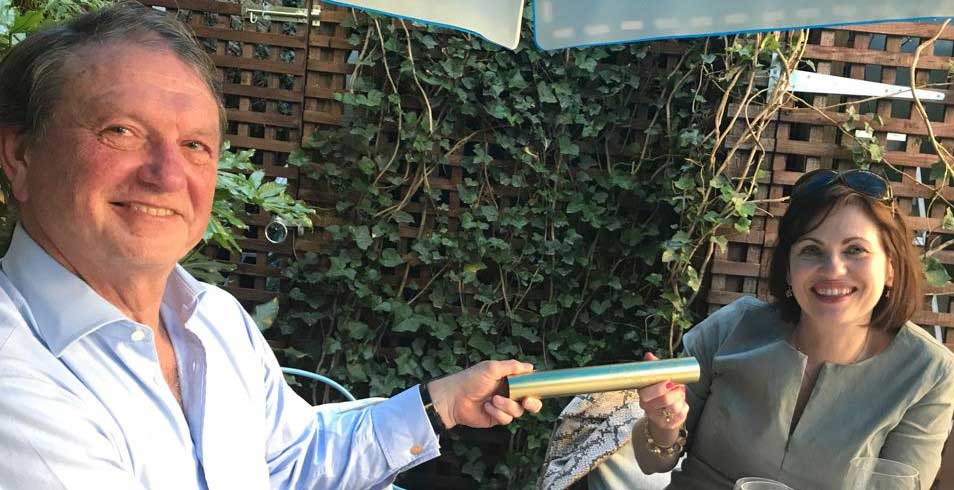
Andrew Stebbings, Former CEO of John Lyon’s Charity
History
John Lyon’s Charity in its modern form was established in 1991, 400 years after the yeoman farmer it is named after, set out to promote education and support ‘the children of poor marriages’. The Rules that encompassed the ‘vision’ for John Lyon’s Charity were approved by the Charity Commission and the Charity began giving grants to benefit the children and young people resident in the nine North and West London boroughs that make up the Charity’s Beneficial Area – the Charity’s ‘patch’.
From the outset the Trustee adopted a policy to support children and young people through Education, with an emphasis on those experiencing poverty and/or disadvantage. Lifting horizons and giving opportunities to individuals was the objective, and disadvantage was not a factor of itself.
In practice, we faced the challenge that it was against the Charity’s founding ‘Rules’ to substitute Government funding. Our interpretation of Education needed to be very broad and firmly embrace access to education, particularly those at risk of not engaging in mainstream education. The Blair “Education, Education, Education” declaration from 1997 led schools to become more creative about extra-curricular activities and that made our task easier in developing relationships with schools, which from the outset, we were keen to ensure were able to access the Charity’s funds directly, as well as supporting the voluntary sector.
Priorities
From the beginning there were three priorities for the Charity:
- Sport – the patch had already produced a number of Olympic athletes and we looked at ways to develop young talent through centres of excellence; this led to establishing the West London Sports Trust (now London Sports Trust).
- Arts – was an area we wanted to nurture by working with the excellent theatres, galleries and museums in our Beneficial Area to develop their reach with children and young people who might not otherwise engage with such organisations.
- Youth work – which had forever been the ‘Cinderella’ sector when it came to working with young people, but whose reach we believed could go far beyond what formal education services were able to do.
A Different Way of Working
New to the Trust & Foundation world and to grant giving, our knowledge of the Charity’s Beneficial Area and the charitable activity within it was limited to the personal knowledge of the Charity’s three members of staff (each having been brought up in the area, albeit from very different backgrounds) and between us we knew that there was good work being done for local communities by small, local charities and that there were talented people to support. But it was immediately clear that our own knowledge would not be enough.
We knew that we needed to get out into the community to discover and to engage with the extraordinary variety of community groups, youth clubs and schools that worked with the children and young people for whom the Charity’s funds were for. Right from the beginning, ‘grant giving by walking around’ was adopted as a cornerstone of the Charity’s method of grant giving. The adopted practice of visiting all projects to assess their effectiveness, rather than rely solely on written applications, became integral to the Charity’s practice. This method has proved hugely successful for the Charity’s grant giving and allowed the Charity to develop successful and constructive relationships with the organisations it is supporting.
We began to develop the Charity’s grant giving process and understand the voluntary sector by recognising its challenges and how to respond most effectively to gaps. We were finding the Charity’s place and honing our craft. The Charity has always recognised that whilst education was at the heart of its work, education is viewed in its widest sense and that supporting young people to be safe, secure and supported ensured that children and young people could then thrive through their formal education. The Charity increasingly found confidence to support organisations across its Beneficial Area who provided every opportunity to level the playing field and broaden horizons – for all young people, irrespective of background. Thus, another important component of the Charity’s grant giving began to emerge as a cornerstone – its role as a place-based funder.
Our position was underpinned by the knowledge that the Charity wasn’t going away: after 450 years, with a closely defined area of benefit and a large endowment, it was worth stakeholders engaging with us. And they could do so with confidence in our long-term support, uninfluenced by the vagaries of politics and changing government policies.
Borough Consultation
At the time that the Charity was establishing its Rules with the Charity Commission (1991), the Trustee was obliged to consult with the nine Local Authorities in our patch about our grants. The original purpose of the Rules was to act as a constraint on the Charity, principally to avoid us funding projects which left the Local Authority with a future funding burden. At the outset we wanted to be open with the boroughs about what we expected from the consultation process and to engage with all of them to share ideas, discuss areas of concern where Local Authority funding was constrained, and share examples of best practice.
It was immediately evident that those nine Local contributed to achieving much more strategic investment in their boroughs through their engagement with us, thereby maximising the amount of money awarded by the Charity. This helped give the Charity greater influence in the local voluntary sector, where it was one of the largest external non-government funders, even in the very early days when the income available to distribute was just c£1.5m.
Whilst at the outset this consultation looked to be irksome, it has instead proved to be a helpful and fruitful addition to the way that the Charity works. We are now trusted not only as a funder, but as a partner and collaborator with Local Authorities.
Expansion
As the Charity expanded, we developed a culture of sharing new ideas, initiatives and projects, actively engaging with proposals to improve it and, on occasions, to embrace our own ideas and initiatives. Under Cathryn Pender’s direction this was encouraged and gave confidence to each of us in our roles. I was a bystander, responsible for money and the endowment and throwing in the occasional idea for someone else to pursue. I hope that allowed me to give the team the best possible support, as a cheerleader and advocate for the staff to give them the encouragement and confidence to move in challenging new directions – which they took, leading the Charity to become the organisation that it is today.
Passing the Baton
It will be forty years in 2023 since my involvement with the Charity began and I am very proud of the Charity that has been created, or should I say how it has been re-born. Many people have contributed to the organisation as it is today, but I must record my thanks to Julia Kaufmann who acted as mentor to us all, Cathryn Pender as brilliant and long-standing Grants Director and Chairs Nick Stuart – with his vast knowledge and experience of government and the education sector – and Susan Whiddington – who knew the sector intimately as the Founder and CEO of Mousetrap Theatre Projects.
Lynne Guyton took on the baton (yes, there really is one!) nearly six years ago with great success, developing collaborations with other funders and a new focus on raising the Charity’s profile for the benefit of grantees, including creating a strong social media presence, which is almost beyond my comprehension. After 450 years, to me the Charity is set on course for a long and successful future; the last thirty years a mere blink.